

A Simple Buying Guide: Choose your Commercial Combi Oven
 Author
Jacob Harrison
Author
Jacob HarrisonPosted On 10th August 2026
How to Choose the Right Commercial Combi Oven for Your Kitchen
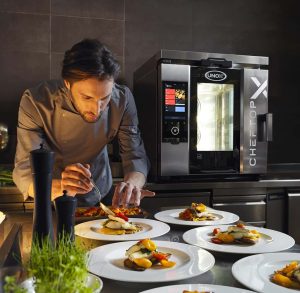
A commercial combi oven is one of the biggest investments you’ll make for your kitchen, and one of the most worthwhile if you get it right. This commercial combi oven buying guide walks through what actually matters: the oven can take over from several pieces of equipment at once, speed up service, and open up what your menu can actually do. Get it wrong, though, and you’re left with an expensive piece of kit that never quite suits the way your kitchen runs.
Here’s what actually matters when you’re weighing up your options.
What this combi oven buying guide covers
A combi oven combines three ways of cooking in one unit: convection (dry heat), steam, and a mix of the two. That’s really the whole appeal of it. The same oven can roast, steam, bake, poach and reheat, so it often replaces a separate steamer and convection oven, and sometimes a hold-o-mat too.
1. Boiler vs boilerless (injection) steam generation
This is usually the first big decision, and it shapes both what you pay upfront and what you’ll pay to run it.
Boiler models make steam using an internal boiler tank. They give you more consistent, higher-quality steam, which is why they’re usually the pick for high-volume kitchens. The trade-off is a higher price tag and more maintenance, particularly descaling.
Boilerless (also called injection) models spray water directly onto a heating element instead. They cost less and are simpler to look after, though steam output can dip slightly when you’re pushing high volumes through.
If you’re running a busy kitchen with heavy steam use, think large-scale batch cooking or a hotel doing banqueting, a boiler model tends to pay for itself over time. For a smaller café, a pub kitchen, or anywhere with lower volume, boilerless is usually the more practical choice.
2. Size and capacity
Combi ovens are sized by how many 1/1 GN (gastronorm) pans they hold. Common sizes run 6, 10, 20 and upwards. It’s easy to talk yourself into buying bigger “just in case,” but that decision costs you three times over: a higher price, more energy use, and space in your kitchen you probably needed for something else.
As a rough starting point:
- 6 to 10 grid suits cafés, small restaurants and pubs
- 10 to 20 grid suits mid-size restaurants and hotels
- 20 grid and up suits high-volume kitchens, contract catering and larger hotels
Size for your busiest service, not your average day. But try not to buy for a level of business you’re unlikely to see for years.
3. Gas vs electric
Both are common, and the right answer usually comes down to what’s already in your kitchen and what matters more to you: running costs or ease of installation.
Gas tends to be cheaper to run where gas prices are favourable, and plenty of chefs simply prefer how responsive it feels. Electric ovens are generally easier and cheaper to install, since you’re not dealing with the same gas supply or extraction requirements, and they tend to give you more precise control over temperature.
If you’re fitting out a kitchen from scratch, electric is often the simpler route logistically. If you’re swapping out an existing gas oven in the same spot, staying with gas can save you on installation.
4. Control type: manual vs programmable
Manual controls are simple and reliable, and they cost less. They suit smaller teams and simpler menus where you’d rather have flexibility than automation.
Programmable, touchscreen controls let you save cooking programs for specific dishes. That’s a genuine advantage for bigger teams, multi-site businesses, or kitchens with less experienced staff. You get more consistency and cut down on training time.
5. Cleaning and maintenance
Combi ovens work hard every day, so it’s worth taking the built-in cleaning systems seriously rather than treating them as an afterthought.
Automatic cleaning systems save real staff time and help stop grease and scale building up on the oven’s internal parts. Water filtration or softening matters a lot if you’re in a hard water area too. Untreated water wears out boiler components a lot faster, and a surprising number of avoidable service call-outs come down to scale build-up that could’ve been prevented.
6. Servicing and support
You’ll likely be running a combi oven daily for eight to ten years or more, so it’s worth thinking past the purchase price. Before you buy, it’s worth checking:
- What’s actually covered under warranty, and for how long
- Whether engineers and parts are easy to get hold of in your area, and that any gas engineer is listed on the Gas Safe Register
- Realistic turnaround times for servicing, since every day the oven’s down is a day of lost service
Quick summary
| Consider | Choose this if… |
|---|---|
| Boiler steam | High-volume kitchen, heavy steam use |
| Boilerless steam | Lower volume, want simpler maintenance |
| Bigger grid size | High peak covers, batch cooking |
| Smaller grid size | Café, pub kitchen, limited space |
| Gas | Existing gas supply, chef preference |
| Electric | New install, precise temperature control |
| Programmable controls | Larger team, consistency across shifts |
| Manual controls | Small team, simpler menu |
Browse our range
Take a look at our full range of Commercial Combi Ovens, or if you’re still weighing up your options, compare them against our Convection Ovens. Once you’ve settled on the right oven, our Oven Accessories range has everything you’ll need to get it up and running.
Not sure which combi oven suits your kitchen? Get in touch with our team and we’ll help you work it out.