

Commercial Dishwasher Buying Guide: How to Choose the Right Machine
 Author
Jacob Harrison
Author
Jacob HarrisonPosted On 9th October 2026
Commercial Dishwasher Buying Guide: How to Choose the Right Machine
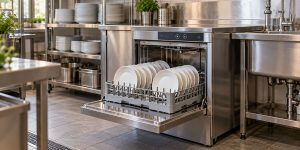
This commercial dishwasher buying guide covers what actually matters when choosing a machine: capacity, basket sizes, installation requirements and whether a dishwasher or glasswasher is the better fit for your business.
Your dishwasher needs to keep up with your busiest service, fit the space available and work with your kitchen’s existing utilities. Choose the wrong machine and even a good dishwasher can become a bottleneck.
1. Commercial dishwasher or glasswasher: what’s the difference?
The first question is what you’re going to be washing most often. A commercial dishwasher is generally designed for plates, bowls, cutlery and suitable kitchenware. A glasswasher is designed around drinking glasses and barware, with baskets and wash settings suited to glasswashing.
If you’re running a restaurant kitchen where most of the washing is crockery and cutlery, a dishwasher is usually the more practical starting point. If you’re running a pub or bar where glasses need turning around throughout service, a dedicated glasswasher may make more sense.
Can a commercial dishwasher wash glasses?
Some can, but don’t assume every machine is equally suited to both jobs. Wash programmes, baskets, chemical settings and the type of glassware all matter.
Certain machines can also be configured for different applications. The Classeq C500, for example, can be configured for dishwasher or glasswasher operation. That’s a useful reminder to check the exact model and setup rather than relying on the product category alone.
If glassware is your main concern, start by comparing our Undercounter Glasswashers.
2. Types of commercial dishwasher
Once you’ve established what needs washing, the next decision is how the machine will fit into your kitchen’s working routine.
Undercounter dishwashers
Undercounter dishwashers are front-loading machines that can fit beneath a suitable worktop. They’re often a practical choice for cafés, pubs and smaller restaurant kitchens, particularly where floor space is limited.
The main advantage is their compact footprint. The trade-off is that staff need to load and unload racks through the front door, which may become less convenient as washing volumes increase.
If this arrangement suits your kitchen, browse our Undercounter Dishwashers.
Passthrough dishwashers
Passthrough dishwashers, also called hood-type dishwashers, are designed for a different workflow. Staff slide a loaded rack into the machine, lower the hood for the wash cycle and then move the clean rack out.
They’re worth considering when a smaller front-loading machine is creating a bottleneck. With suitable inlet and outlet tables, a passthrough setup can make it easier to organise dirty and clean crockery during busy service.
You’ll need more room for the machine, the hood to open and the surrounding working area. See our Passthrough Dishwashers if you’re planning a dedicated washing station.
Rack conveyor dishwashers
Rack conveyor dishwashers are intended for operations handling substantial quantities of washing. Rather than loading individual racks into a stationary washing chamber, racks move through the machine as part of a continuous process.
They can make sense for large canteens, institutional kitchens and other high-volume operations, but require considerably more planning around space, utilities and the flow of dirty and clean items.
Our Rack Conveyor Dishwashers category covers this type of equipment.
Specialist utensil and pot washers
Not everything that needs washing is a plate or glass. Large pans, cooking utensils and gastronorm containers can be awkward or unsuitable for a standard dishwasher, depending on their size and the machine’s design.
If these items make up a significant part of your washing load, it’s worth considering specialist utensil and pot washers rather than choosing a conventional dishwasher and hoping everything will fit.
3. What size commercial dishwasher do you need?
Capacity is easy to underestimate, particularly if you’re replacing a machine that already struggles to keep up. Think about the busiest period of service, not just the average number of dishes washed throughout the day.
Wash cycles and racks per hour
Manufacturers often measure capacity in wash cycles or racks per hour. These figures help you compare machines, but they don’t always reflect what happens during a busy service.
Staff still need time to clear food waste, load baskets and put clean items away. Some machines also need extra time between cycles. So, check the rated capacity, then think about how many racks your team can realistically handle.
Basket sizes and loading height
Basket size matters just as much as speed. A machine might offer enough cycles per hour but still be unsuitable if your largest plates, trays or utensils won’t fit.
Check the basket dimensions and usable loading height, not just the external dimensions of the dishwasher.
If you use unusually large plates, deep bowls or tall items, confirm that they can be loaded correctly before ordering.
Planning for peak demand
Think about when washing accumulates. A restaurant with a concentrated lunch rush may have different requirements from a café washing smaller quantities steadily throughout the day.
It’s also worth considering whether crockery needs to be returned to service immediately or whether you have enough spare stock to manage short delays.
Buying more capacity than you need can increase purchase and installation costs. Buying too little can leave staff waiting for clean crockery at exactly the wrong time.
4. Commercial dishwasher installation requirements
A dishwasher can look suitable on paper and still be the wrong choice for your premises. Before ordering, check what the machine needs from your electrical supply, plumbing and available space.
Electrical supply
Commercial dishwashers are available with different electrical requirements. Some models are offered in 13A versions, while others require a dedicated higher-rated or three-phase supply.
Don’t assume that two machines with similar dimensions can use the same electrical connection. Check the exact model and variant, and have a qualified electrician confirm that the available supply is suitable.
Water supply and pressure
Machines can differ in their incoming water temperature, connection and pressure requirements. Some have rinse booster pumps or other features that affect installation.
Check the manufacturer’s specification against the water supply available at your premises. Where requirements aren’t met, ask your installer or supplier what needs addressing before the machine is fitted.
Gravity drainage vs drain pumps
Drainage is easy to overlook, but it can affect which dishwasher you can install.
A gravity-drain machine needs a suitable waste outlet so water can flow away naturally. A drain pump gives you more flexibility with the waste connection. However, every pump has limits, so you’ll still need to check the manufacturer’s installation instructions.
Before ordering, make sure the machine’s drainage requirements match your existing plumbing.
Water softeners and water hardness
Hard water can cause limescale to build up inside your dishwasher. Over time, this can affect washing results and increase maintenance needs.
Some machines have a built-in water softener. Others need a separate unit. The right choice depends on your local water hardness and the manufacturer’s instructions.
Check this before installation to help avoid scale problems later.
Space, access and working clearance
Measure more than the gap where the dishwasher will sit.
An undercounter machine needs enough room to open its door and load racks comfortably. A passthrough dishwasher needs clearance above the hood, as well as suitable loading and unloading space.
Check the delivery route too. Doorways, corridors and tight corners can be just as important as the final installation position.
5. Running costs, cleaning and maintenance
Purchase price is only part of the cost of owning a commercial dishwasher, but running costs aren’t determined by the machine alone.
Water and electricity consumption vary between models and wash programmes. Your actual costs will also depend on how often the machine runs, how efficiently racks are loaded, utility tariffs and the chemicals being used.
Regular cleaning, correct detergent and rinse-aid settings, and appropriate water treatment all matter. Following the manufacturer’s maintenance instructions can help keep the machine working as intended.
Before buying, check what routine care is required, what’s covered by the warranty and whether servicing and replacement parts are readily available.
6. Commercial dishwasher buying checklist
Before settling on a machine, make sure you can answer the following:
- What needs washing? Mostly crockery and cutlery, glassware, or larger pots and utensils?
- Which machine type suits the workflow? Undercounter, passthrough, conveyor or specialist equipment?
- What happens during your busiest service? Can the machine handle the washing that builds up at peak times?
- Will your items fit? Check basket dimensions and usable loading height.
- Is there enough space? Allow for doors, hoods, surrounding tables and staff movement.
- Is the electrical supply suitable? Confirm the requirements of the exact model.
- Will the water supply and drainage work? Check pressure, connections and waste position.
- Is water treatment needed? Consider local hardness and the manufacturer’s guidance.
- What does ownership involve? Check chemicals, routine cleaning, servicing and warranty terms.
If you’re unsure about any of these, it’s better to resolve them before placing an order than after the machine arrives.
7. Commercial dishwasher FAQs
Do commercial dishwashers need a hot water supply?
Not always. Some models can accept a cold-water supply, while others have particular incoming water-temperature requirements. The machine may also need to heat incoming water before it is ready for use.
Check the specification for the exact model rather than assuming every commercial dishwasher connects in the same way.
Can you use a domestic dishwasher in a commercial kitchen?
A domestic dishwasher may not be designed for the frequency of use, turnaround times or operating demands of a busy commercial kitchen.
The suitability of any appliance also depends on the business’s hygiene procedures and applicable requirements. If you’re buying equipment for regular professional warewashing, compare commercial machines designed for that workload rather than relying on domestic specifications alone.
Quick summary
| Consider | What matters |
|---|---|
| Dishwasher or glasswasher | What you’re washing most often |
| Undercounter | Compact footprint and front-loading workflow |
| Passthrough | Busy service and organised rack movement |
| Rack conveyor | Sustained high-volume washing |
| Capacity | Peak demand, basket size and loading height |
| Installation | Electrical supply, water, drainage and clearance |
Browse our range
Once you’ve worked out the machine type, capacity and installation requirements, take a look at our range of Commercial Dishwashers and Glasswashers to compare suitable options.
Still not sure which machine suits your kitchen or bar? Get in touch with our team and we’ll help you narrow down the options.